Your Cart is Empty

Wedderspoon uses two clear ways to describe its Mānuka honey: KFactor, which refers to the honey’s floral source and Mānuka pollen content, and MGO, which measures methylglyoxal. They are different grading systems, so a KFactor number cannot be converted directly into an MGO number.
This guide covers Wedderspoon Mānuka honey only. Every jar is sourced from New Zealand and selected products are independently tested to verify their MGO rating or meet the New Zealand Government’s Mānuka standard. Choose a grade based on the flavour, format and strength that fit the routine—not a medical claim.
| Grade | What it means | Choose it if | Available option |
|---|---|---|---|
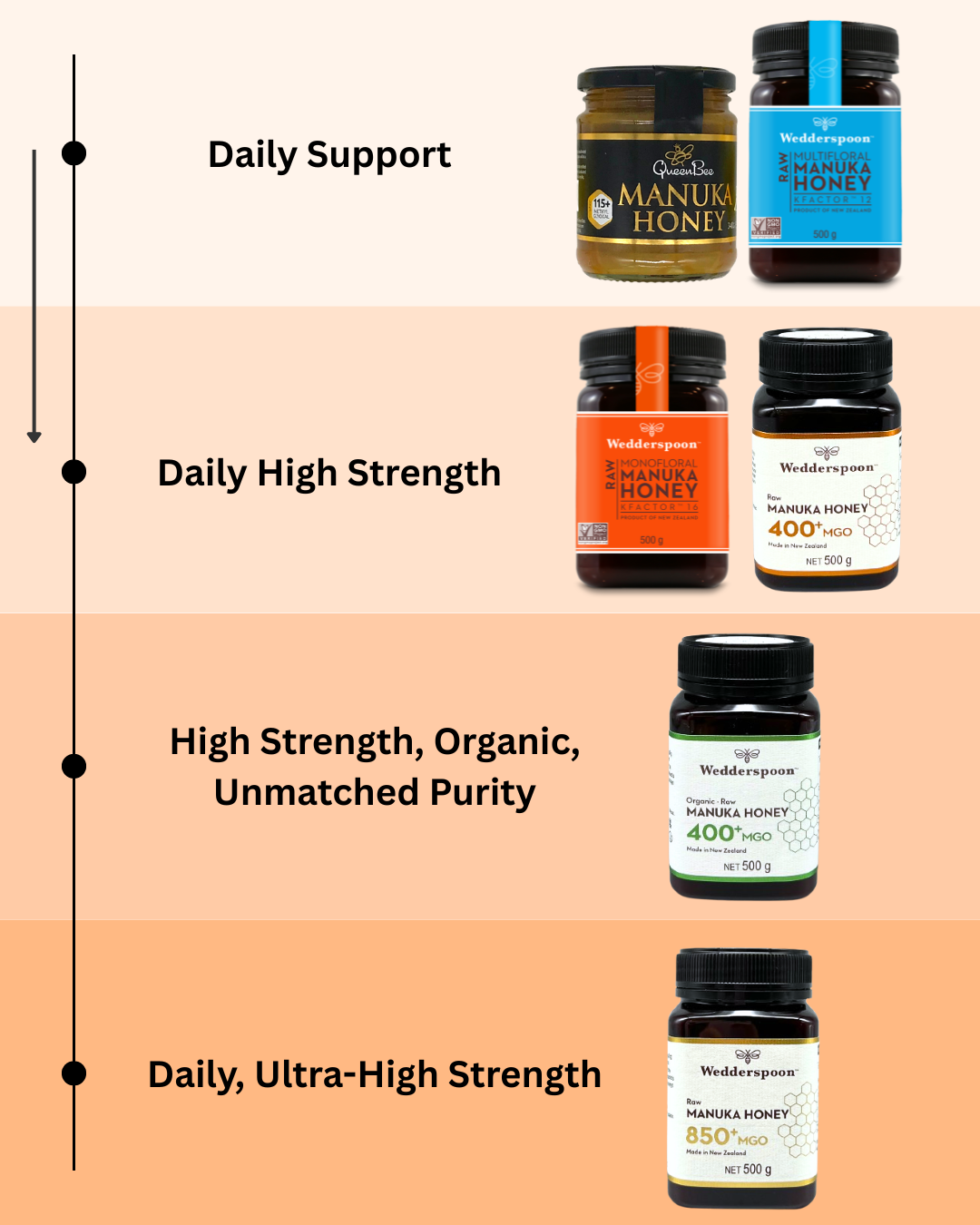
| KFactor 12 | Multifloral Mānuka honey with at least 65% Mānuka pollen, as confirmed through Wedderspoon’s quality checks. | Everyday use, a gentle Mānuka flavour, or a first Wedderspoon jar. | KFactor 12, 250g |
| KFactor 16 | Monofloral Mānuka honey with at least 75% Mānuka pollen, meeting or exceeding the New Zealand Government’s monofloral standard. | A more distinctly Mānuka profile, or a convenient on-the-go format. | KFactor 16, 250g or KFactor 16 Snap Packs |
MGO is a measure shown as milligrams per kilogram of honey. A higher MGO number indicates a higher measured level of methylglyoxal; it does not make one jar universally right for every person.
| MGO grade | What to expect | Choose it if | Available option |
|---|---|---|---|
| 400 MGO | A higher-strength Wedderspoon Mānuka honey with its MGO level verified for quality and authenticity. | You want a higher MGO grade for a regular pantry jar. | 400 MGO, 250g or 400 MGO, 500g |
| 850 MGO | One of the highest-strength jars in the Wedderspoon range, independently tested by a New Zealand government-approved laboratory. | You specifically want Wedderspoon’s highest available MGO grade. | 850 MGO, 250g or 850 MGO, 500g |
No. KFactor refers to Wedderspoon’s floral-source grading, while MGO measures methylglyoxal. Compare products within the same grading system rather than trying to convert one directly into the other.
For an everyday introduction, KFactor 12 is a practical starting point. Choose KFactor 16 for monofloral Mānuka honey, or 400 MGO and 850 MGO when an MGO-labelled jar is preferred.
Enjoy it by the spoonful, on toast, through porridge or yoghurt, or stirred into a warm drink. Avoid presenting Mānuka honey as a treatment for a health condition.
Choosing Mānuka honey can feel a bit confusing at first. This guide keeps things simple so you can easily choose the right one for you.
Mānuka honey is a special type of honey produced in New Zealand from bees that pollinate the Mānuka bush. It is known for its unique naturally occurring compounds, and is specially tested and graded. Here is a quick comparison of Mānuka honey vs regular honey:
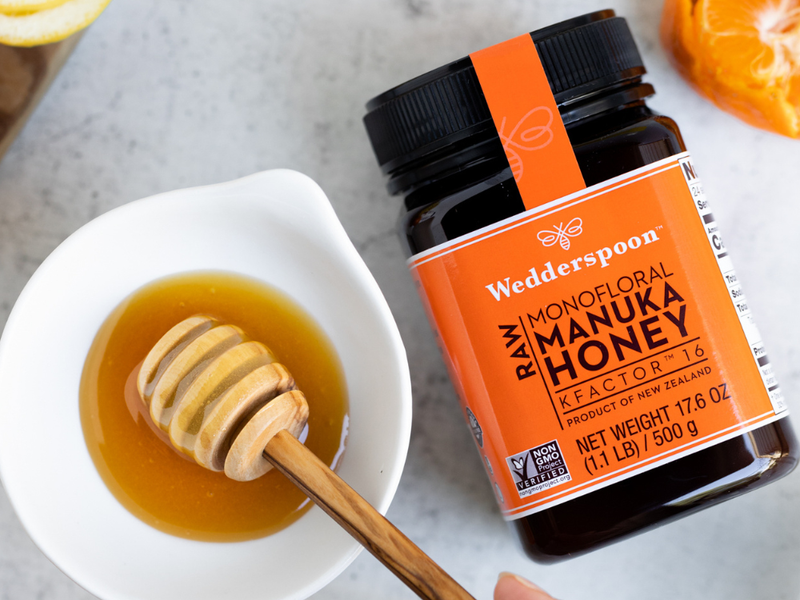

Made from bees pollinating the mānuka bush in New Zealand

Produced and tested in New Zealand

Graded using systems like MGO or KFactor

Known for its unique naturally occurring compounds

Often considered a more premium type of honey, typically more expensive & varies in price
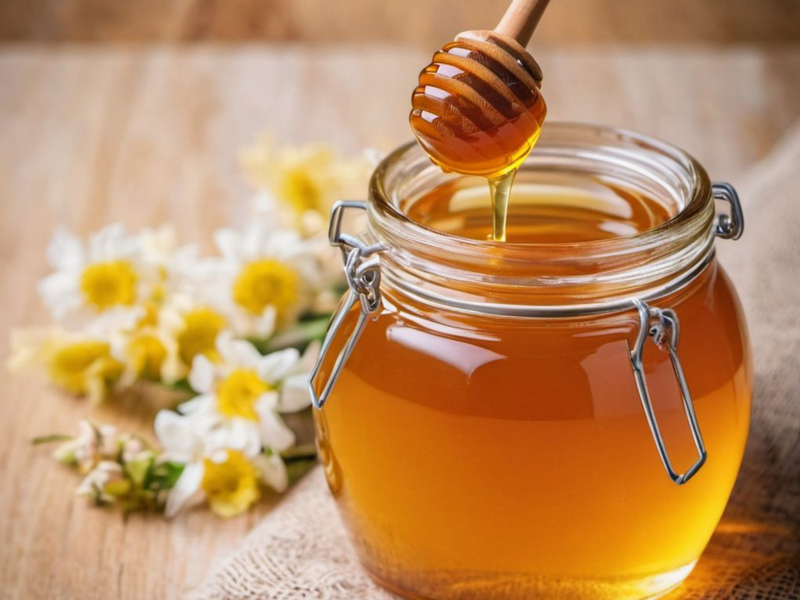
Made from a variety of flowers
Produced in many countries around the world
Usually not graded for strength
Popular for everyday sweetness and flavour
Typically lower in price
MGO tells you the measured methylglyoxal concentration; KFactor is Wedderspoon’s separate grading system focused on mānuka authenticity. They are not equivalent numbers. Choose MGO if you want to compare a stated concentration, or KFactor if you prefer Wedderspoon’s authenticity-led grading.
Measures the concentration of methylglyoxal naturally present in the honey.
Best for:Customers looking for a simple strength-based grading system.
Wedderspoon’s own grading system, designed to reflect authentic Mānuka honey more broadly.
Best for:Customers who prefer a broader authenticity-focused grading system.
In a complex market, this level of transparency helps confirm you are choosing genuine, verified Mānuka honey.
Mānuka honey is more expensive than standard honey because it is carefully sourced, tested, and graded rather than treated as a bulk commodity.
Limited supply — only produced in specific regions of New Zealand.
Strength grading — higher MGO levels are rarer and more valuable.
Independent testing — each batch is verified for quality and authenticity.
Traceability —tracked from hive to jar for full transparency.
Raw handling — minimal processing to preserve natural properties.
Size differences — larger jars naturally cost more than smaller ones.
The best Mānuka honey for you depends on what matters most to you — whether that is a familiar grading system, a specific strength, an organic option, a more portable format, or a glass jar.
A different way of understanding Mānuka honey quality and authenticity.
If you are looking for a simple place to start, two of the most popular jars in our range are Wedderspoon KFactor 16 500g and Wedderspoon MGO 400 500g.
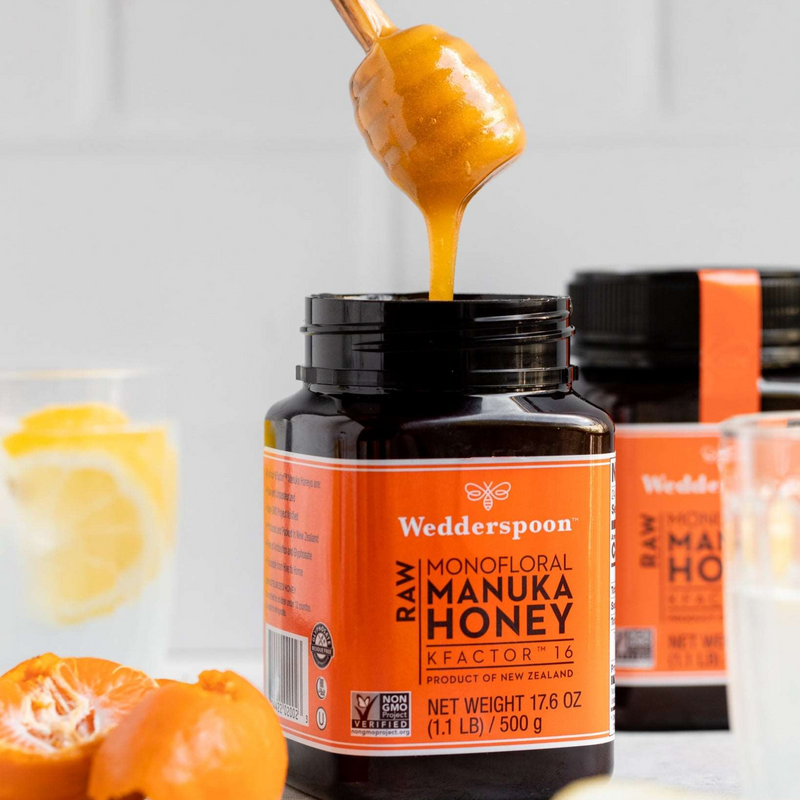
A trusted favourite for customers who prefer Wedderspoon’s traditional grading system and a more “authenticity-led” approach.
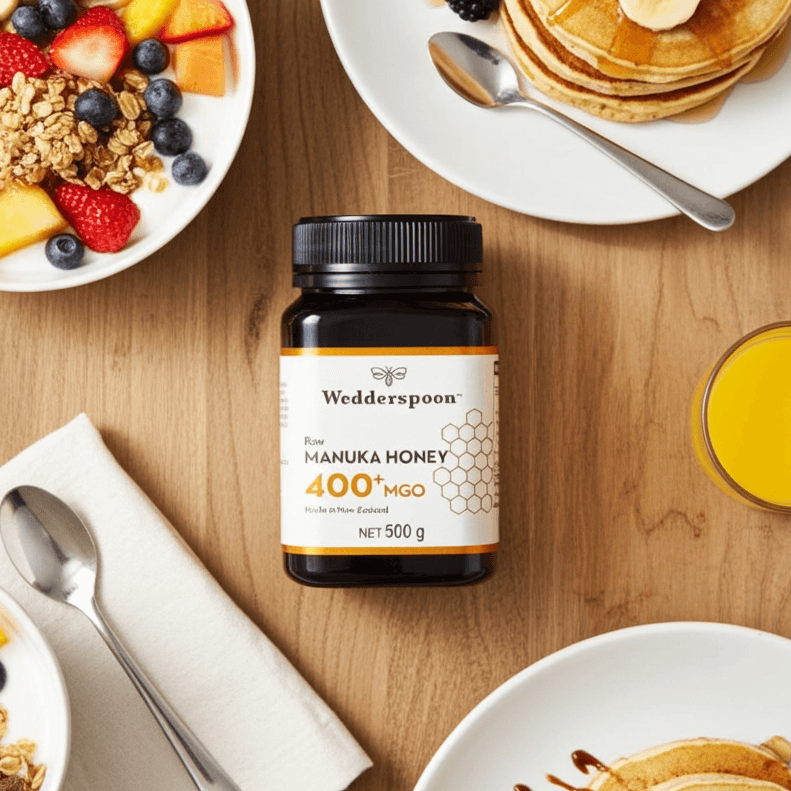
A popular everyday choice for customers who prefer a simple, easy-to-understand strength rating.